Scopely has agreed to acquire Turkish developer Loom Games in a deal valued at up to $1 billion, marking one of the company’s most ambitious expansion moves to date.
At the center of the acquisition is Pixel Flow, a fast-growing puzzle title that has already attracted more than 10 million players within six months of launch — a performance that signals strong early product-market fit.
The deal represents Scopely’s largest acquisition since its purchase of the games business from Niantic, further reinforcing its strategy of scaling globally through both acquisitions and internal growth.
Backed by Saudi Investment: A Long-Term Strategy
Scopely’s aggressive expansion is closely tied to its ownership by Savvy Games Group, which acquired the company in 2023 for $4.9 billion.
Savvy’s broader ambition is clear: invest tens of billions into gaming and esports to position itself as a global leader capable of competing with Tencent in the $100+ billion mobile gaming market.
Since the acquisition, Scopely has experienced rapid growth, with reported revenues surpassing $4 billion annually, supported by strong performance across its portfolio.
Building a Multi-Franchise Powerhouse
Scopely’s strategy is not centered around a single hit — it is focused on building a diversified portfolio of high-performing franchises.
Key drivers of its growth include:
- Monopoly Go, which has generated billions in player spending
- The acquisition of Pokémon Go and other titles
- A growing list of franchises each exceeding $1 billion in revenue
According to market intelligence firm Sensor Tower, Scopely ranks as the top mobile publisher in the United States by in-app purchase revenue, second globally only to Tencent.
A Developer Perspective: Why Studios Like Loom Matter
From a development standpoint, the acquisition highlights an important industry reality:
👉 Innovation is increasingly coming from smaller, agile teams.
Loom Games, founded just last year with a team of around 20 developers, managed to build a product capable of reaching millions of players in a short time.
This reflects a broader trend where:
- Small teams iterate faster
- Unique gameplay ideas gain traction quickly
- Publishers act as scaling engines rather than creators
For large publishers like Scopely, acquiring such studios is not just about the game — it’s about talent, speed, and innovation pipelines.
Turkey’s Emergence as a Global Gaming Hub
The acquisition also reinforces Turkey’s growing importance in the mobile gaming industry.
In recent years, the country has produced several high-value studios:
- Peak Games — acquired by Zynga for $1.8 billion
- Dream Games — creator of Royal Match, valued near $5 billion
These successes highlight Turkey as a key talent hub, particularly in puzzle and casual game development.
Scopely’s move signals continued confidence in the region’s ability to produce globally scalable hits.
Growth in a Slower Market
The timing of the acquisition is notable.
The mobile gaming industry is entering a more mature phase, with growth slowing:
- Global market growth around 2.9% annually (according to Newzoo)
- Increased competition for user attention from platforms like TikTok and YouTube
- Rising user acquisition costs
Despite these challenges, Scopely continues to outperform the market, largely due to its focus on LiveOps, monetization, and scalable IP.
The Bigger Strategy: Diversification and Risk Reduction
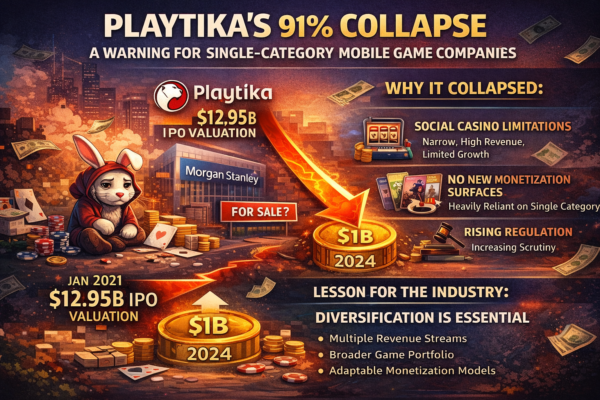
One of the most important aspects of this deal is diversification.
While Monopoly Go remains a major revenue driver — reportedly surpassing $6 billion in lifetime spending — Scopely is actively working to avoid dependence on a single title.
The Loom acquisition reflects a broader strategy:
- 📌 Expanding through targeted acquisitions
- 🎮 Investing in internal game development
- 🌍 Building global studio partnerships
- 📈 Scaling multiple revenue-generating franchises
This approach reduces risk while increasing long-term growth potential.
Why This Deal Matters for the Industry
The acquisition highlights several key trends shaping the future of gaming:
- 🌍 Continued consolidation in mobile gaming
- 🇸🇦 Large-scale sovereign investment entering the industry
- 🇹🇷 Rising importance of emerging development markets
- 📈 Shift toward portfolio-based growth strategies
It also reinforces the idea that success in modern gaming is no longer just about building games — it’s about building ecosystems of talent, technology, and distribution.
Looking Ahead
With Pixel Flow already demonstrating strong early traction, Scopely’s investment in Loom Games could pay off significantly if the title continues to scale globally.
More importantly, the acquisition positions Scopely to:
- Access new creative talent
- Expand into emerging markets
- Strengthen its competitive position against global leaders
As the mobile gaming market becomes more competitive and growth slows, strategic moves like this will likely define the next generation of industry leaders.
Source:
This article is based on reporting originally published by the Financial Times and supported by industry data.