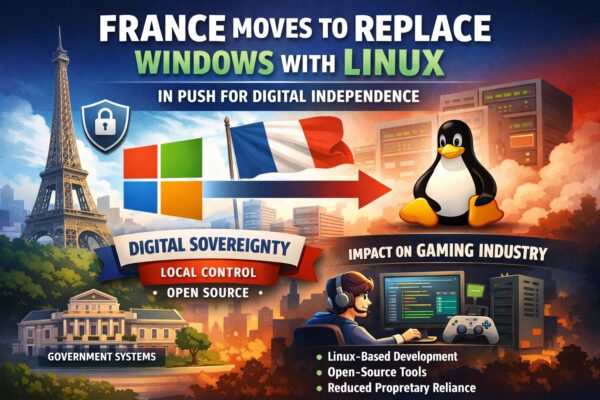
France has announced plans to reduce its reliance on U.S. technology by gradually replacing Microsoft Windows with Linux across parts of its government infrastructure.
The move is part of a broader strategy to regain control over national digital systems and data, as governments across Europe become increasingly focused on what is known as digital sovereignty.
A Strategic Shift in Government Technology
French officials have emphasized that the transition is aimed at reducing dependence on foreign technology providers and strengthening control over sensitive systems.
The migration will begin with systems used by the government’s digital agency, DINUM, although no official timeline or specific Linux distribution has been confirmed.
This decision reflects growing concern among European governments about relying too heavily on external platforms for critical infrastructure.
Why Linux?
Linux offers a fundamentally different approach compared to proprietary systems like Windows.
As an open-source platform, it allows organizations to:
- Access and modify the source code
- Customize systems based on their needs
- Avoid licensing costs
- Reduce reliance on a single vendor
For governments, this level of control is especially important when dealing with national data, security, and long-term infrastructure planning.
Part of a Broader Digital Sovereignty Movement
France’s move is not happening in isolation. Across Europe, policymakers are increasingly focused on building independent digital ecosystems.
Efforts already underway include:
- Reducing reliance on foreign cloud providers
- Promoting locally developed software solutions
- Strengthening control over data storage and processing
These initiatives aim to create more resilient and self-controlled digital systems at a national and regional level.
Beyond Operating Systems
The transition away from Windows is just one part of a larger shift.
France has already taken steps to reduce dependence on U.S. tools by replacing Microsoft Teams with solutions based on Jitsi and planning to move sensitive data to locally controlled platforms.
This indicates a broader effort to rebuild the entire digital stack — from communication tools to infrastructure — under national control.
A Technical Perspective
From a development standpoint, moving to Linux offers flexibility and control, but also introduces challenges.
While Linux allows deeper customization and transparency, it requires:
- Strong internal technical expertise
- Compatibility adjustments for existing software
- Long-term maintenance planning
Large-scale migrations of this type are complex and typically take years to fully implement.
What This Means for the Gaming Industry
While this decision is primarily focused on government infrastructure, it also has indirect implications for the gaming industry.
Many game development tools, servers, and backend systems already rely heavily on Linux environments. A broader shift toward open-source platforms could:
- Encourage more developers to adopt Linux-based workflows
- Strengthen open-source tools used in game development
- Reduce dependence on proprietary ecosystems over time
Although the immediate impact is limited, the trend toward digital independence may gradually influence how game studios approach infrastructure and development pipelines.
Looking Ahead
France’s move signals a growing shift in how countries view technology — not just as a tool, but as a strategic asset.
If successful, this transition could inspire other nations to:
- Adopt open-source solutions
- Reduce reliance on foreign providers
- Build more independent digital ecosystems
For now, the initiative represents a clear direction:
👉 Control over technology is becoming a priority at the national level.
Source:
This article is based on reports and statements regarding France’s digital strategy and transition plans.