With artificial intelligence dominating the tech conversation, a recurring question continues to surface among aspiring developers:
👉 Is it still worth learning game development in the age of AI?
👉 Will platforms like Steam become oversaturated with AI-generated games?
These concerns are understandable — but they may be based on a misunderstanding of what AI actually is.
AI Is a Tool — Not a Replacement
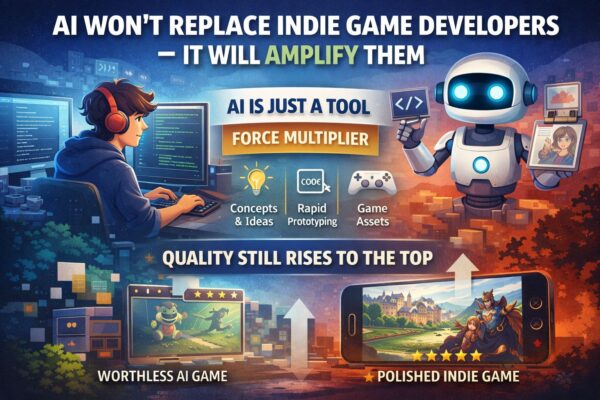
At its core, AI is not a creator. It is a tool.
Throughout history, progress has always followed the same pattern:
👉 Humans + tools competing with other humans + tools
AI is simply the latest addition to that equation.
Just like game engines, asset stores, or programming languages, AI doesn’t replace skill — it enhances it.
Why AI Alone Cannot Create Great Games
There is a common misconception that AI can fully replace developers.
In reality, if someone with no experience asks AI:
“Make me a game like GTA 6”
The result will almost always be:
- Generic
- Incomplete
- Lacking design depth
- Technically limited
Without knowledge of programming, design, or game systems, AI outputs quickly become unusable.
This is because:
👉 AI does not understand intent — it reflects input.
A Multiplier for Skilled Developers
For experienced developers, however, AI can be extremely powerful.
Used correctly, it becomes a force multiplier, helping with:
- Prototyping ideas faster
- Writing boilerplate code
- Generating concepts or assets
- Automating repetitive tasks
From a developer perspective, the real advantage comes when you:
👉 Know exactly what you want
👉 Know how to guide the tool
👉 Know how to refine the output
In that context, AI doesn’t replace skill — it amplifies it.
The “Steam Flooding” Myth
Another common fear is that AI will flood platforms like Steam with low-quality games.
But this concern is not new.
The same argument appeared when asset marketplaces became popular:
“Steam will be full of asset flips and low-effort games.”
While it’s true that more content was created, the impact on serious developers remained limited.
Why?
Because platforms like Steam rely heavily on algorithms and player behavior.
Quality Still Rises to the Top
Even today, Steam hosts thousands of low-quality or experimental titles.
However, those games rarely compete with:
- Well-designed indie games
- Properly marketed releases
- High-quality player experiences
From a professional standpoint:
👉 You are not competing with “AI Game #42”
👉 You are competing with other serious developers
The platform is already designed to:
- Surface high-quality content
- Filter out low-effort projects
- Promote games that retain player engagement
A Developer Perspective: What Really Matters
From a real-world game development perspective, success has never depended on tools alone.
It depends on:
- Game design quality
- Execution
- Polish
- Marketing
- Player retention
AI does not solve these challenges.
It can help with production speed — but it cannot replace:
- Creativity
- Decision-making
- Experience
The Bigger Picture
AI will likely increase the number of games being created — that part is true.
But more content does not automatically mean more competition at the top.
Instead, it creates a wider gap between:
- Low-effort projects
- High-quality, well-executed games
For serious developers, this can actually be an advantage.
Should You Still Learn Game Development?
The answer is simple:
👉 Yes — now more than ever.
AI makes skilled developers more efficient, not obsolete.
Those who understand programming, design, and systems will always have an advantage over those who rely purely on automation.
Looking Ahead
AI will continue to evolve, and its role in game development will expand.
But its purpose will remain the same:
👉 To assist — not replace — developers.
For indie developers willing to learn, adapt, and build quality experiences, the future remains just as promising as ever.