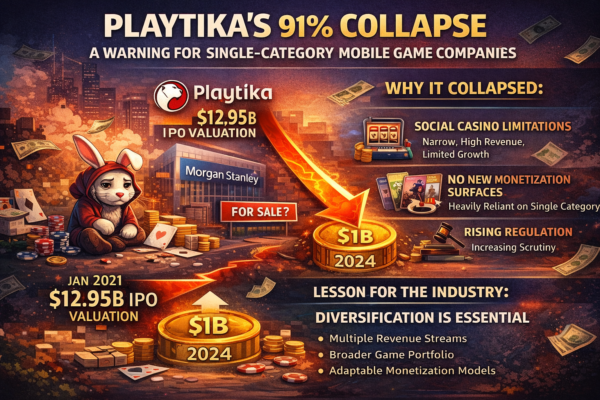
When Playtika went public in January 2021, it did so with a $12.95 billion valuation, marking one of the largest tech IPOs to come out of Israel.
Today, the company’s market cap sits near $1 billion.
That represents a 91% decline in just five years — and now, with Morgan Stanley hired to explore a sale, the story is entering a new phase.
But this isn’t just a case of a struggling company. It’s something more important.
Not a Failure — A Shift in the Market
Playtika is not a failed business.
It remains:
- Profitable
- Backed by real revenue
- Supported by a large user base
- Built on established, long-running titles
Technically, the company succeeded.
Commercially, however, the market moved — and Playtika didn’t move with it.
The Timeline of a Decline
The company’s trajectory tells a clear story:
- 2021: IPO at $12.95 billion, celebrated as a major tech milestone
- 2022: First attempt to sell the company — no buyers
- 2024: Executive departures and continued pressure on the category
- 2025: Declining performance in casual and mobile segments
- 2026: Second attempt to sell, with a significantly lower valuation
At its current enterprise value of roughly $2.7–$2.9 billion, the company is worth far less than it was during its first attempted sale.
The key question now is:
👉 Will a buyer even emerge this time?
The Real Problem: Category Limitations
The deeper issue isn’t Playtika itself — it’s the category it operates in.
Playtika is heavily focused on social casino games, a segment known for:
- High revenue per user (ARPU)
- Shorter retention curves
- Limited audience expansion
- Increasing regulatory pressure
This model works extremely well — until it reaches its ceiling.
Once growth slows, there are few natural paths to expand beyond the core audience.
A Developer Perspective: The Risk of Narrow Focus
From a game development and business standpoint, Playtika’s situation highlights a critical lesson:
👉 Building one strong monetization model is not enough.
Even if a company executes perfectly within a single category, it remains vulnerable to:
- Market saturation
- Regulatory changes
- Shifts in player behavior
- Platform competition
Without diversification, growth eventually stalls.
Why No Buyer Stepped In
Back in 2022, when Playtika first explored a sale, the company was still valued highly.
However, buyers stayed away.
Why?
- The growth narrative was weak
- The category was already under pressure
- The valuation did not match future potential
Now, with a significantly lower valuation, the situation has changed — but uncertainty remains.
The Bigger Trend in Mobile Gaming
Playtika’s story reflects a broader shift in the mobile gaming industry.
The next generation of successful companies will likely be those that:
- Operate across multiple genres
- Build long-term player ecosystems
- Own direct relationships with users
- Use data to optimize across multiple monetization layers
In other words:
👉 The future is not about one game or one category — it’s about platforms and ecosystems.
What This Means for the Gaming Industry
For the gaming industry, Playtika’s decline highlights a key structural change:
- Single-category dominance is becoming risky
- Diversification is becoming essential
- Monetization models are evolving
Companies that rely on a single revenue stream may struggle to adapt as the market shifts.
The $12.95 Billion Lesson
Playtika built a highly efficient business within the social casino space.
But efficiency alone is not enough when:
- Growth slows
- Markets mature
- Competition increases
The companies that will survive the next cycle are those that can expand beyond their initial success and build multiple growth surfaces.
Looking Ahead
As Playtika searches for a buyer, its future remains uncertain.
However, its journey offers a clear takeaway for developers, publishers, and investors:
👉 Success in mobile gaming is no longer just about building great games —
👉 It’s about building adaptable, scalable business models.
Source:
This article is based on market data, company performance trends, and industry analysis of Playtika’s valuation and strategic direction.